


B.Sc./M.Sc.-Arbeiten und Forschungspraktika:
Während einem Forschungspraktikum besteht die Möglichkeit zu einem Einblick in eine Vielzahl an spektroskopischen Methoden zur Untersuchung von paramagnetischen Verbindungen. Die erhaltenen Daten müssen dann analysiert werden. Forschungspraktika erlauben auch das Modellieren und Simulieren von zuvor gewonnenen Daten.
Die Arbeitsgruppe van Slageren bietet die folgenden Themen für Bachelor- und Masterarbeiten an:

FP-Project
Supervisor: Jake McGuire
Goal:
This project will focus on the synthesis of a nuclear spin free phthalocyanine (Figure 1.). Phthalocyanines are capable of complexing a range of metals in the N4 core. This structure is literature known but has never been used to complex paramagnetic metal ions. The goal of this project is to synthesise this ligand and incorporate some paramagnetic metal ions and investigate the spin dynamic properties of these molecules.
Methods:
- Electrochemistry (cyclic voltammetry and EIS)
- Spectroelectrochemistry
- Cw X-band EPR Spectroscopy
- Electronic Spectroscopy
Background:
Quantum information processing (QIP) exploits the quantum properties of materials to give exponential speed up to specific, but societally relevant, computational tasks, and is poised to revolutionize computation in doing so. The fundamental unit of a QIP device (quantum computer/simulator/sensor) is the qubit, a quantum body that can be placed in a superposition between two or more states. Performance of a molecular quantum bit is measured by the length of its coherence time, the longer the better. Practically, the coherence time is described in two parts. The longer T1, the spin-lattice relaxation time, describes energetic relaxation processes. T2, the spin-spin relaxation time, accounts for magnetic relaxation processes. To achieve the maximum possible coherence times, energetic relaxation must be minimized, and sources of magnetic noise must be eliminated. Operationally, a T2 of 1 ms is required for an electron spin-based qubit (as this would allow 104 gate operations with a gate time of 10 ns). This has never been achieved before and is due to small magnetic contributions from nuclear spins in the surrounding environment. We propose synthetic pathways to eliminate nuclear spins to achieve T2 long enough to make MQBs viable for QIP.
B.Sc./M.Sc.-Projekt
Betreuer: Claudia Franke
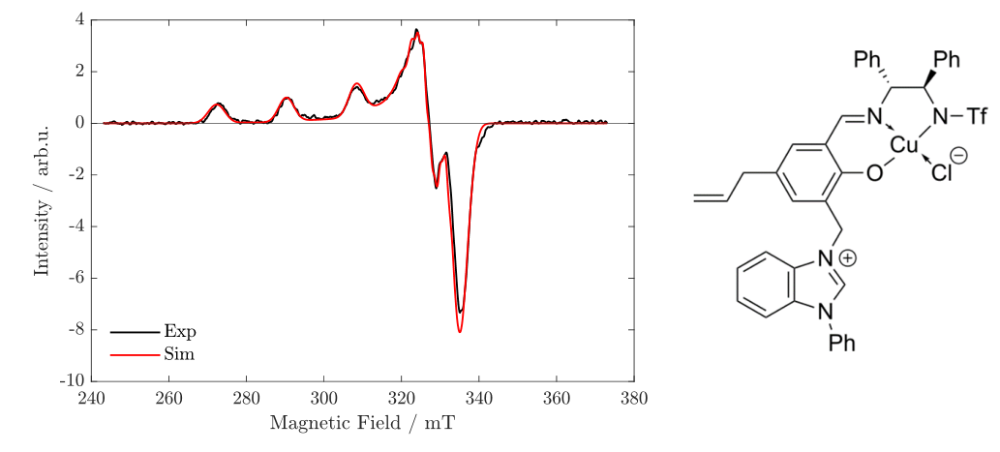
Ziel: Spektroskopische Charakterisierung eines Katalysatorsystems. Aufklärung der aktiven Spezies sowie die Untersuchung der Reaktionskinetiken unter verschiedenen Reaktionsbedingungen mittels ESR.
Methoden:
- X-Band ESR bei Raumtemperatur
- Weitere Spektroskopische und magnetometrische Methoden
- Datenauswertung mit Python und Matlab (keine Vorkenntnisse nötig)
Hintergrund:
Katalyse mit hoher Stereo- und Enantioselektivität sind von zentraler Bedeutung für pharmazeutische Anwendungen. Die Bestimmung der Reaktionsmechanismen solcher Reaktionen ist schwierig und oft von theoretischen Rechnungen abhängig. Spektroskopische Methoden können eine wichtige zusätzliche Perspektive geben und zur mechanistischen Aufklärung beitragen.
B.Sc./M.Sc./FP-Project
Supervisor: Jake McGuire
Goal: Investigation of spin-electric coupling in highly-tunable molecular spin qubit architectures. The influence of spin-state, spin-orbit coupling, and delocalization and symmetry on spin-electric coupling.
Methods:
- Electrochemistry (cyclic voltammetry and EIS)
- Spectroelectrochemistry
- Cw X-band EPR Spectroscopy
- Cw spin-electric X-band EPR Spectroscopy
- Pulsed Q-band EPR
- Electronic Spectroscopy
- Simulation
Background:
Molecular quantum bits (MQBs) are promising candidates as the hardware of a quantum computer. As these devices are being physically realized with super-conducting bits or nitrogen-centered vacancies in diamond, the addressability of the quantum bits (qubits) poses a severe bottleneck, that is, the ability to write and read data to these qubits. Magnetic fields are intrinsically difficult to control and change in the precise regime required for operation of a quantum computer is incredibly limiting with current technology. In contrast, electric field generation and control is trivial. Paramagnetic molecules, with specific geometries among other conditions, can couple with electric fields, dubbed spin-electric coupling. However, this effect is conventionally quite weak. Using the high tunability of molecular systems we look to develop design principles to maximize spin-electric coupling, while preserving the properties required for MQBs; long coherence times.
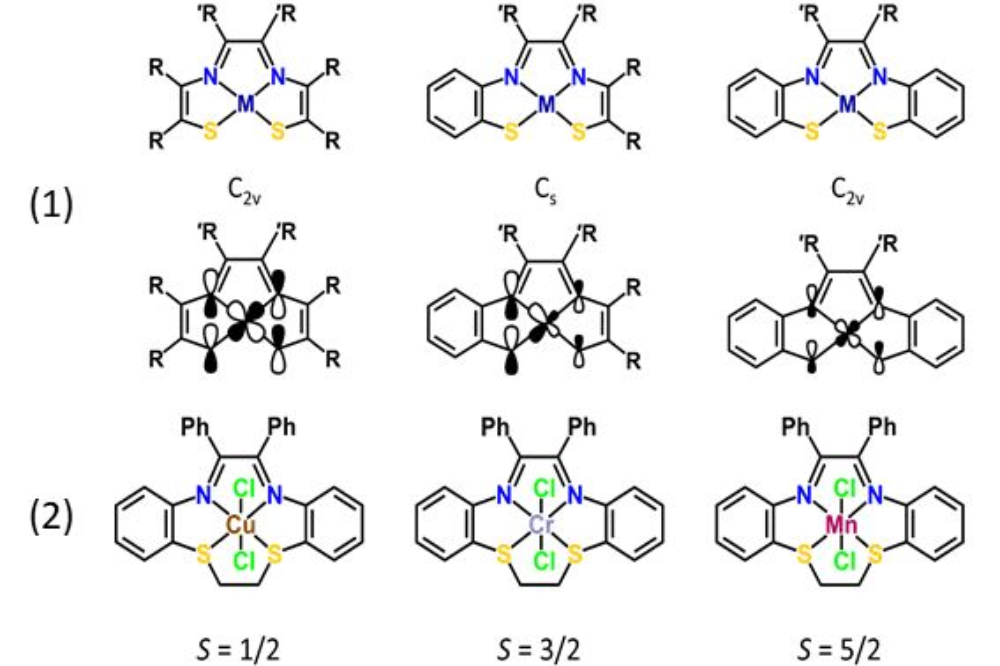
It is known that spin-electric coupling is operative locally in paramagnetic molecules without inversion centers. N2S2 tetradentate fused bis(aminothiolate)s have been known since the 60s and exhibit coordination to a wide range of metals. They can, in some cases, undergo reduction to form radical ligands. A slight caveat is that their tunability has not been fully explored. In-group, some methodology has been developed towards customizing these to fully capitalize on this system.
Known transition metal complexes, such as those in figures 1 (Examples of fused bis(aminothiolate) complexes with varied symmetry and, therefore, electron distribution where M is Ni, Pd, or Pt) and 2 (A series of S,S′-ethyl-N,N′-benzyl-bis(benzeneaminothiolate) (ebbbat) complexes with varying spin state. [Cu(ebbbat)Cl2], [Cr(ebbbat)Cl2], and [Mn(ebbbat)Cl2] with S = 1/2, 3/2, and 5/2 respectively), form convenient series to explore the influence of spin-orbit coupling or spin state. With these we look to fully investigate and characterize the magnetic and electronic properties of these complexes and further develop experimental methodology to investigate spin-electric coupling, which at present consists of connection of the sample between two electrodes and sweeping the field.
This project has wide scope and can be tailored to the interests of the student, whether that be measurement, synthesis, simulation, or development.
Bei Interesse an einer Abschlussarbeit in der Arbeitsgruppe van Slageren bitte Kontakt mit Prof. Joris van Slageren aufnehmen.
